I’ve always been fascinated by the idea of vehicles that can seamlessly transition from road to sky. The concept of a flying car feels like something straight out of a sci-fi movie, yet here we are, standing on the brink of making it a reality. It’s incredible to think how far technology has come, from early prototypes like the Taylor Aerocar to modern innovations that push the boundaries of what’s possible.
One of the biggest challenges has been creating a vehicle that functions equally well on the ground and in the air. Early models, often referred to as roadable aircraft, sparked public imagination but faced significant hurdles. Today, advancements in design and engineering are bringing us closer than ever to solving these dual-use challenges.
This guide will take you through the journey of flying cars, from their historical milestones to the cutting-edge technology shaping their future. Whether you’re a tech enthusiast or simply curious, this is your ultimate resource to understand how close we are to seeing these vehicles become a common part of our lives.
Key Takeaways
- Flying cars combine road and air travel, presenting unique design challenges.
- Early prototypes like the Taylor Aerocar laid the groundwork for modern innovations.
- Advancements in technology are making flying cars more feasible than ever.
- This guide covers historical milestones, current developments, and future possibilities.
- Regulation and safety remain key factors in the widespread adoption of flying cars.
Introduction to Flying Cars
The dream of vehicles that can travel both on roads and in the air has captivated minds for decades. These dual-purpose machines, often called roadable aircraft, combine the convenience of a car with the freedom of a helicopter. They represent a unique blend of automotive and aviation technology, pushing the boundaries of what’s possible in transportation.
Early prototypes like the Autoplane and Waterman’s Arrowbile laid the groundwork for this ambitious concept. These models were inspired by science fiction visions and aimed to solve the challenges of creating a functional dual-purpose vehicle. However, turning this idea into a working reality has always been a complex task.
One of the biggest hurdles is designing a system that works seamlessly on both land and in the air. Early attempts often struggled with weight, safety, and efficiency. Yet, recent advancements in development have brought us closer than ever to solving these issues. Innovations in electric propulsion and autonomous systems are paving the way for a new era of transportation.
“The future of mobility lies in the convergence of road and air travel.”
From the Convair Model 118 to modern eVTOLs, the journey of roadable aircraft has been marked by significant milestones. Regulatory efforts have also played a crucial role in shaping the current landscape. As we march forward, the dream of a flying car is no longer just a fantasy—it’s a tangible possibility.
Understanding the Flying Car Concept
Combining the functionality of a car and an aircraft into one machine is a fascinating concept. This idea, often referred to as a roadable aircraft, aims to create a versatile vehicle that can operate on both roads and in the air. The challenge lies in designing a system that seamlessly transitions between these two modes of transport.
One of the key aspects of this concept is the integration of automotive and aviation technology. For example, the Terrafugia Transition features folding wings, allowing it to function as a car on the road and an aircraft in the sky. This innovative design highlights the engineering required to balance road safety and flight capability.
Advanced systems are crucial for enabling a vehicle to switch between driving and flying modes. These systems must manage weight, stability, and efficiency while ensuring safety. Recent advancements in technology are addressing these challenges, making the flying car concept more feasible than ever.
“The future of transportation lies in the convergence of road and air travel.”
Examples like the Terrafugia Transition demonstrate the core principles of this concept. As design and engineering continue to evolve, the dream of a dual-purpose vehicle is becoming a tangible reality. With regulatory support and technological breakthroughs, the flying car is no longer just a sci-fi fantasy.
Historical Milestones in Roadable Aircraft
The journey of roadable aircraft began with bold experiments in the early 20th century. Inventors like Glenn Curtiss and Waldo Waterman were among the first to dream of a vehicle that could conquer both land and sky. Their pioneering work laid the foundation for the development of dual-purpose machines.
In 1917, Curtiss introduced the Autoplane, a type vehicle that combined car and aircraft features. Though it never flew, it sparked public imagination. Waterman’s Arrowbile, unveiled in 1937, became the first successful flying vehicle. Only five units were produced, but it marked a significant step forward.
The 1940s saw the rise of the Fulton Airphibian, a design that featured removable wings and tail sections. While innovative, it struggled with practicality. These early prototypes faced challenges in weight, safety, and efficiency. Yet, they pushed the boundaries of aviation and automotive technology.
“The early 20th century was a time of daring ideas and bold experiments in transportation.”
Media coverage of these projects fueled public fascination. Newspapers and magazines often portrayed them as the future of mobility. This cultural enthusiasm kept the dream of a roadable aircraft alive, inspiring later innovations.
These early milestones set the stage for modern efforts. The lessons learned from these prototypes continue to influence the development of hybrid vehicles today. As we look back, it’s clear that the march toward a functional flying vehicle has been a journey of persistence and creativity.
Early Innovations in Flying Car Development
The early 20th century was a time of bold experimentation in transportation. Inventors dared to dream of a vehicle that could seamlessly transition from land to sky. These pioneers laid the groundwork for what we now call car roadable aircraft, blending automotive and aviation technologies.
Pioneering Prototypes and Experiments
One of the earliest attempts was the ConVairCar, a design that featured detachable wings and a rear-mounted propeller. Though innovative, it faced challenges in weight distribution and safety. Similarly, the Arrowbile introduced folding wings, making it one of the first functional prototypes.
The Autogiro Company’s AC-35 also played a significant role. It utilized a unique propeller system and detachable components, showcasing the potential of dual-purpose transport. These early models revealed both the promise and limitations of roadable aircraft.
Lessons from Early 20th Century Designs
Early experiments taught valuable lessons. Weight management was a critical issue, as these vehicles needed to balance road safety with flight capability. Safety concerns also emerged, especially during transitions between modes.
“The first prototypes were a testament to human ingenuity, but they also highlighted the complexities of merging two distinct technologies.”
Despite their limitations, these early designs inspired future innovations. The use of detachable wings and modular components became a cornerstone of later designs. These formative experiments paved the way for more reliable and efficient models.
Mid-Century Concepts and Prototypes
The mid-20th century marked a turning point in the evolution of dual-purpose vehicles. Designers began experimenting with innovative propulsion methods, including early jet technologies and combustion engines. This era saw the rise of bold ideas that pushed the boundaries of what was possible.
One notable example is the ConvAirCar, a concept that featured detachable wings and a rear-mounted propeller. While it showcased potential, challenges like weight distribution and safety limited its success. Similarly, the Avrocar, an experimental vehicle designed for military use, struggled with stability and performance.
Scientific research in aerodynamics played a crucial role in refining these prototypes. Engineers focused on balancing power with safety, often testing unconventional designs. These efforts laid the groundwork for modern development in hybrid transportation.
“The mid-century era was a time of bold experimentation, where science and imagination collided to redefine mobility.”
Despite their limitations, these mid-century concepts inspired future innovations. They demonstrated the potential of combining automotive and aviation technologies, paving the way for today’s advancements. The lessons learned from this era continue to shape the future of dual-purpose vehicles.
Modern Breakthroughs and Advancements
Recent advancements in transportation have brought us closer to a future once reserved for science fiction. The flying car concept, once a distant dream, is now being realized through cutting-edge technology and innovative designs. Companies like XPeng and AeroMobil are leading the charge, transforming prototypes into near-market solutions.
One of the most exciting developments is the use of advanced materials and propulsion systems. Lightweight composites and electric motors are making these vehicles more efficient and environmentally friendly. For example, eVTOLs produce 35% less emissions than petrol cars for journeys under 100km, showcasing their potential for sustainable air mobility.
Autonomous systems are also playing a crucial role. XPeng’s Aero and AeroMobil’s latest models incorporate AI-driven controls, enabling seamless transitions between driving and flying modes. These advancements are solving longstanding challenges, such as weight distribution and safety, bringing us closer to a functional flying car.
“The convergence of automotive and aviation technologies is redefining the future of transportation.”
Efforts in both flight and automotive testing are converging to address key issues. For instance, the V.MO’s eight-rotor design minimizes noise and maximizes efficiency, making it a promising candidate for urban air mobility. Such innovations highlight the progress being made in this field.
As these projects move closer to public reality, I’m excited to see how they’ll reshape our world. The future of transportation is here, and it’s more thrilling than ever.
Flying Cars: Technology and Innovation
Innovative engineering is unlocking the potential of dual-mode vehicles. The integration of advanced systems is making it possible to seamlessly transition between road and air travel. These breakthroughs are reshaping the future of transportation.
One of the key advancements is the use of specialized propellers. These components are designed to provide both lift and efficiency, ensuring smooth transitions between modes. For example, the AirCar’s transformation from a car to an aircraft takes just over two minutes, showcasing the precision of modern technology.
Another critical element is the aerodynamic design. Engineers are focusing on lightweight materials and efficient shapes to optimize performance. Features like folding and detachable wings help manage space and weight, making these vehicles more practical for everyday use.
The interplay between road dynamics and airborne performance is a major focus. Advanced autopilot and multi-rotor systems are addressing challenges like stability and safety. These innovations are key to overcoming the hurdles of dual-mode transportation.
“The future of mobility lies in the seamless integration of road and air travel.”
Companies like eHang are leading the way, with their electric flying taxi receiving a safety certification in 2023. This milestone highlights the progress being made in this field. As these vehicles move closer to public use, the possibilities for urban air mobility are becoming increasingly tangible.
Innovation in technology is the driving force behind these advancements. From propulsion systems to aerodynamic designs, every element is being reimagined to create a functional and efficient dual-purpose vehicle. The future of transportation is here, and it’s more exciting than ever.
eVTOL and Autonomous Flight Systems
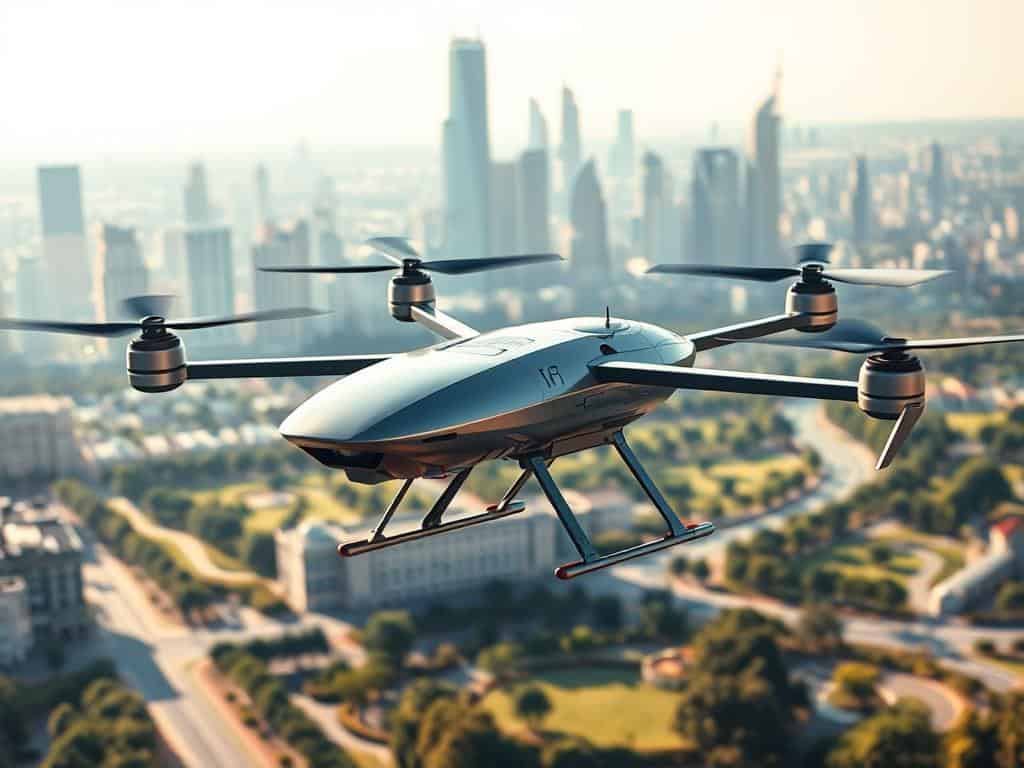
The future of urban mobility is taking to the skies with groundbreaking eVTOL technology. These systems combine advanced rotor configurations with autopilot mechanics to enable vertical takeoff and landing. This innovation is transforming the way we think about transportation, especially in congested cities.
Autopilot and Multi-Rotor Mechanics
One of the key features of eVTOL models is their use of multi-rotor mechanics. These systems rely on multiple blades to provide lift and stability during flight. For example, Archer’s Midnight aircraft uses eight rotors, ensuring redundancy and safety. This design minimizes the risk of single-point failures, making it a reliable option for urban aviation.
Autopilot technology plays a crucial role in ensuring smooth and safe maneuvers. Advanced algorithms and sensors allow these vehicles to navigate complex environments with precision. Wisk’s Generation 6 aircraft, for instance, is the first candidate for FAA certification as a passenger autonomous model. This milestone highlights the progress being made in this field.
Integration of Vertical Takeoff Systems
Vertical takeoff and landing (VTOL) is a defining feature of eVTOL models. These systems use specialized propellers to transition seamlessly between ground and air travel. The Y6S eVTOL aircraft, for example, achieves a maximum cruise speed of 125 mph and a range of 80 miles, making it ideal for short-distance urban trips.
“The integration of VTOL technology is redefining the possibilities of urban mobility.”
Recent test flights, like Volocopter’s public demonstration in Dubai, validate the practicality of these systems. With noise levels below 65 dB during takeoff, eVTOLs are designed to blend into urban environments. The FAA’s new Mosaic framework is also facilitating rapid development, bringing us closer to widespread adoption.
From autopilot mechanics to VTOL integration, these advancements are reshaping the future of transportation. As these models move closer to public use, I’m excited to see how they’ll revolutionize urban mobility and reduce congestion.
Design and Engineering Challenges
Designing a vehicle that operates seamlessly on both land and air presents unique engineering challenges. The need to balance road safety with flight efficiency requires innovative solutions. From materials to structural integrity, every aspect must be carefully considered to meet both automotive and aerospace standards.
Dual-Purpose Structures for Road and Air
Creating a dual-purpose vehicle involves addressing conflicting requirements. On the road, the design must ensure durability and impact resistance. In the air, lightweight materials are essential for efficient flight. For example, detachable wing systems allow for easy transitions but add complexity to the overall structure.
Wheel placement is another critical factor. The front wheels must support ground stability while not interfering with aerodynamic performance. This often requires innovative engineering to ensure the vehicle functions smoothly in both modes.
Safety versus Weight Trade-offs
One of the biggest challenges is balancing safety with weight. Lightweight materials like composites are ideal for flight but may compromise road safety. Engineers must find a middle ground, ensuring the vehicle is both airworthy and road-safe.
Safety certifications from both industries add another layer of complexity. Meeting automotive crash standards while adhering to aerospace regulations requires extensive testing and validation. This often increases cost, making the design process more challenging.
“The integration of road and air safety standards is a monumental task, but it’s essential for the future of dual-purpose vehicles.”
Lessons from past prototypes, like the Terrafugia Transition, highlight the importance of modular designs. These models have paved the way for current innovations, showing that with careful planning, the dream of a functional dual-purpose vehicle is achievable.
Powertrain and Propulsion Solutions
The evolution of propulsion systems is reshaping the future of transportation. As we explore dual-mode vehicles, the choice between combustion engines and electric power becomes critical. Each option has its strengths and challenges, influencing the design and functionality of these innovative machines.
Combustion Engines vs. Electric Power
Traditional combustion engines have long been the backbone of aviation and automotive industries. They offer high power output and are well-suited for long-distance travel. However, they come with drawbacks like higher emissions and fuel cost. In contrast, electric power provides a cleaner, more sustainable alternative. Electric motors are quieter, require less maintenance, and are ideal for short to medium distances.
Recent test flights of electric prototypes have shown promising results. For example, eVTOLs produce 35% fewer emissions than petrol vehicles for trips under 100km. This makes electric propulsion a strong contender for urban air mobility. Yet, challenges like battery weight and charging infrastructure remain.
Hybrid and Advanced Thrust Systems
Hybrid systems combine the best of both worlds. They use internal combustion engines alongside electric motors to enhance performance and efficiency. For instance, hybrid electric propulsion systems (HEPSs) optimize power distribution, ensuring smooth transitions between driving and flying modes.
Advanced thrust systems, like dedicated propeller and jet configurations, are also gaining traction. These systems minimize weight while generating the required thrust for flight. Innovations in propeller design, such as folding blades, help manage space and improve aerodynamics.
“The future of mobility lies in the seamless integration of road and air travel.”
Balancing power needs for road performance and flight requirements is a significant challenge. Engineers must ensure that the system is both powerful and lightweight. Economic considerations also play a role, as manufacturers seek cost-effective yet powerful solutions.
As propulsion technology advances, the possibilities for dual-mode vehicles continue to expand. From hybrid systems to electric propellers, these innovations are key to the next wave of transportation breakthroughs.
Navigating Regulatory and Certification Hurdles
Navigating the regulatory landscape for dual-mode vehicles is a complex but essential step toward their widespread adoption. For a car roadable aircraft to operate legally, it must meet stringent certification requirements for both road and air travel. This dual certification process involves multiple government agencies and industry bodies, each with its own set of standards.
One of the biggest challenges is balancing road safety with airworthiness. For example, the FAA and EASA have different approaches to certification. The FAA focuses on risk-based standards, while EASA combines conventional and performance-based models. These differences can create hurdles for companies trying to bring their prototypes to market.
Prototypes often face conflicting regulatory requirements. A vehicle designed for smooth road performance may struggle to meet aviation safety standards. This adds to the overall cost and complexity of development. Despite these challenges, some companies have made significant progress. For instance, Alef Aeronautics recently secured a Special Airworthiness Certificate from the FAA for their Model A prototype.
“The integration of road and air safety standards is a monumental task, but it’s essential for the future of dual-purpose vehicles.”
Looking ahead, improvements in regulation could ease market entry. Collaborative efforts between agencies and public education campaigns will play a crucial role. As these advancements unfold, the dream of a functional roadable aircraft becomes increasingly tangible.
Safety Protocols and Operational Standards
Ensuring safety in dual-mode vehicles is a top priority for manufacturers and regulators alike. The integration of road and air safety standards is a monumental task, but it’s essential for the future of transportation. Rigorous testing and certification processes are critical to making these vehicles a reality.
Road and Air Vehicle Certification
Certifying a vehicle for both road and air use involves meeting stringent criteria from agencies like the FAA and EASA. These certifications ensure that the system is safe and reliable in both modes. For example, roadworthiness tests must align with automotive safety standards, while airworthiness requires adherence to aviation regulations.
One of the biggest challenges is balancing conflicting requirements. A vehicle designed for smooth road performance may struggle to meet aviation safety standards. This dual certification process adds complexity and cost to development but is essential for public trust.
Pilot Training and Autonomous Controls
Transitioning between driving and flying modes requires specialized training. Pilots must master both road dynamics and airborne performance, which can be a steep learning curve. To address this, companies are investing in autonomous controls to reduce the skill demands on users.
Advanced systems like collision avoidance technology and real-time weather updates are being integrated to enhance safety. For instance, ballistic recovery parachutes provide a safe descent in case of mechanical failures, while reinforced occupant cells protect passengers during emergencies.
“The integration of road and air safety standards is a monumental task, but it’s essential for the future of dual-purpose vehicles.”
Standardizing safety protocols is vital for widespread adoption. As these vehicles move closer to public use, collaboration between regulators and manufacturers will play a crucial role. The dream of a functional dual-mode vehicle is becoming increasingly tangible, thanks to these advancements.
Flying Cars in Popular Culture and Science Fiction
From childhood, I’ve been captivated by the futuristic visions of personal air travel. The idea of vehicles soaring through the skies has been a staple of science fiction for generations. Movies, books, and TV shows have painted vivid pictures of a world where cars defy gravity, blending the ordinary with the extraordinary.
Iconic films like Blade Runner and The Jetsons set the stage for what we imagine the future of mobility could look like. These stories didn’t just entertain; they inspired real-world innovation. The sleek designs and seamless transitions from road to sky in these fictional portrayals have influenced modern prototypes.
Music and media have also played a role in shaping public fascination. Songs and references in pop culture keep the dream alive, reminding us of the endless possibilities. The cultural impact of these depictions has fueled a collective enthusiasm for turning fiction into reality.
“The line between imagination and innovation is often blurred by the power of storytelling.”
Looking back, early predictions in science fiction seem almost prophetic. What once seemed like pure fiction is now taking shape through advancements in technology. The public’s excitement continues to drive progress, proving that our dreams can shape the future.
As we move closer to making these vehicles a reality, it’s clear that the influence of science fiction extends far beyond entertainment. It’s a testament to the power of imagination and its ability to inspire real-world change.
Industry Spotlight: Key Players and Pioneering Models
The race to revolutionize transportation has brought forward some of the most innovative companies in the world. Among them, XPeng Aero and AeroMobil stand out as leaders in the development of advanced flying vehicles. Their groundbreaking work is shaping the future of personal transport.
XPeng Aero and Emerging Innovations
XPeng Aero has made significant strides with its VTOL system, which allows for seamless transitions between driving and flying. Their latest model incorporates advanced autonomous controls, reducing the need for specialized pilot training. This innovation is a game-changer for urban aviation.
The company has also focused on sustainability, ensuring their vehicles produce minimal emissions. With over 1,000 test hours logged, XPeng Aero is setting new standards for safety and performance. Their collaboration with BMW has further accelerated their development timeline.
AeroMobil’s Groundbreaking Achievements
AeroMobil has been a pioneer in the flying car space, with over 100 patent applications to their name. Their latest model, the AeroMobil 4.0, boasts impressive speeds of 360 km/h in flight and 160 km/h on the road. This dual-purpose vehicle is designed for both practicality and luxury.
The company has invested heavily in rigorous testing, ensuring their models meet the highest safety standards. Their collaboration with Rolls-Royce has brought aerospace expertise into their development process. AeroMobil’s vision of an “Uber of the sky” is becoming a tangible reality.
“The future of mobility lies in the convergence of road and air travel, and these companies are leading the charge.”
Both XPeng Aero and AeroMobil are driving the industry forward with their innovative plans and programs. Their work is not just about creating flying vehicles but redefining how we think about transport. As these models move closer to mass production, the dream of a functional flying car is no longer a distant fantasy.
Economic Viability, Market Trends, and Future Prospects
The economic landscape of advanced transportation is evolving rapidly, with flying cars at the forefront of innovation. While the concept promises to revolutionize transport, several challenges must be addressed to ensure widespread adoption. From production costs to regulatory hurdles, the path to market viability is complex but full of potential.
Cost Analysis and Production Challenges
One of the biggest hurdles is the high cost of production. Developing a dual-purpose vehicle requires cutting-edge technology and specialized materials, driving up expenses. For example, the XPeng AeroHT’s latest model is projected to cost around $280,000, making it inaccessible to most consumers.
Limited economies of scale further complicate the issue. With production volumes still low, manufacturers struggle to reduce costs. However, advancements in technology, such as electric propulsion and modular designs, are expected to lower expenses over time.
Growth Opportunities in Air Mobility
Despite these challenges, the market for air mobility is expanding rapidly. By 2033, the global flying car market is projected to reach $4.9 billion, growing at a CAGR of 45%. Urbanization and the need for efficient transport solutions are key drivers of this growth.
Emerging business models, such as ride-hailing services, could transform regional transport. Companies like Joby Aviation are already testing eVTOLs for urban commutes, offering a glimpse into the future of mobility. Regulatory support, such as the FAA’s plans to finalize rules by 2025, will further accelerate adoption.
“The convergence of technology and regulation is paving the way for a new era of transportation.”
As production scales up and costs decrease, the dream of affordable flying cars could become a reality. With the right investments and innovations, this emerging market has the potential to reshape how we move.
Conclusion
The journey toward making flying cars a reality has been a blend of innovation and persistence. From early prototypes to modern designs, the concept has evolved significantly. Yet, challenges in engineering, safety, and regulation remain.
Advancements in systems like detachable wings and electric propulsion have brought us closer than ever. Companies are pushing boundaries, creating models that balance efficiency and practicality. The future of mobility looks promising.
As we move forward, staying informed about breakthroughs is key. The dream of a flying car is no longer just science fiction—it’s becoming a tangible part of our world.

