Have you ever wondered why you react a certain way without fully understanding why? Or why certain memories or feelings seem to surface unexpectedly? These questions often lead us to explore the mysterious depths of our unconscious mind. It’s a part of us that operates below the level of conscious awareness, yet it influences our thoughts, behaviors, and emotions in profound ways.
Sigmund Freud, a pioneer in psychology, introduced the idea that much of our mental activity happens beneath the surface. He compared the mind to an iceberg, where the conscious part is just the tip. The rest, hidden beneath, holds memories, desires, and conflicts that shape who we are. Modern research in cognitive psychology supports this, showing how our brains process information without us even realizing it.
From dreams to automatic behaviors, the unconscious mind plays a significant role in our daily lives. Understanding it can help us make sense of our actions and emotions. In this article, we’ll dive into the theories and research that shed light on this fascinating topic.
Key Takeaways
- The unconscious mind operates below conscious awareness, influencing behavior and emotions.
- Sigmund Freud’s iceberg analogy explains the hidden depths of the mind.
- Modern cognitive psychology supports the idea of unconscious mental processes.
- Dreams and automatic behaviors are examples of unconscious activity.
- Exploring the unconscious can provide insights into personal behavior and emotional responses.
Introduction to the Unconscious Mind
What drives our actions when we’re not actively thinking about them? This question lies at the heart of understanding the unconscious mind. Unlike conscious awareness, which involves deliberate thought and decision-making, the unconscious operates automatically, shaping our behavior in subtle yet powerful ways.
Freud’s early work laid the foundation for this concept, describing the unconscious as a reservoir of memories, desires, and conflicts hidden from our conscious awareness. Modern cognitive psychology has expanded this view, showing how our brains process information without us even realizing it. For example, studies reveal that stimuli processed outside awareness can still influence our decisions and emotions.
Conscious processes involve active thinking, like solving a math problem or planning a trip. In contrast, the unconscious handles tasks like breathing, walking, or even forming first impressions. Research by Bargh and others demonstrates how priming—exposure to subtle cues—can affect behavior without conscious intent. For instance, participants primed with words related to politeness acted more courteously in subsequent tasks.
“The unconscious mind is like the backstage crew of a theater—it works tirelessly behind the scenes to shape the performance.”
Freud’s theories, while groundbreaking, have been refined by modern science. Today, we understand that the unconscious isn’t just a source of repressed desires but also a hub for automatic skills, implicit learning, and emotional responses. This evolving view sets the stage for deeper exploration into how these hidden processes influence our lives.
Historical Perspectives on the Unconscious
How did the idea of the unconscious shape modern psychology? This question takes us back to the late 19th century, when Sigmund Freud began exploring the hidden layers of the human psyche. His work laid the foundation for understanding how our unconscious mind influences thoughts, feelings, and actions.
Freud’s early methods, like free association and dream interpretation, were groundbreaking. He believed that the unconscious held repressed memories and desires, often revealed through slips of the tongue or dreams. These ideas were supported by case studies of individuals with abnormal behavior, which helped him build his theories.
Freud and Early Definitions
Freud’s view of the unconscious was revolutionary. He described it as a reservoir of memories and conflicts hidden from conscious awareness. His famous iceberg analogy illustrated this concept, with the conscious mind as the tip and the unconscious as the vast, hidden base.
“The unconscious is the true psychic reality; in its innermost nature, it is as much unknown to us as the reality of the external world.” – Sigmund Freud
Early psychologists used hypnosis and case studies to explore these hidden processes. For example, Freud’s work with patients revealed how unresolved conflicts could surface in unexpected ways. This approach shaped the field of psychoanalysis and influenced generations of researchers.
The Evolution of the Concept
Over time, the understanding of the unconscious evolved. While Freud focused on repressed desires, modern psychology expanded the concept. Researchers like John Bargh studied automatic behaviors and priming effects, showing how subtle cues can influence actions without conscious intent.
Landmark studies in social-cognitive research further refined the idea. For instance, studies on implicit learning revealed how individuals acquire skills and knowledge without awareness. This shift from a singular, rigid view to a more nuanced perspective has deepened our understanding of the unconscious.
Today, the unconscious is seen as a complex system that shapes behavior in multiple ways. From automatic processing to emotional responses, it continues to be a central focus in psychology. This historical journey highlights the importance of exploring hidden mental processes to better understand ourselves.
Theories in Cognitive Psychology and Automatic Processing
What happens when our brain processes information without us knowing? Cognitive psychology offers fascinating insights into how our minds handle tasks without active involvement. These theories focus on automatic processing, which occurs outside our conscious awareness yet influences our behavior and decisions.
Subliminal Processing Overview
Subliminal processing refers to how our brains respond to stimuli below the threshold of conscious awareness. For example, flashing a word too quickly to be consciously recognized can still affect our thoughts. However, equating unconscious processing solely with subliminal stimuli is limiting. It overlooks the broader ways our minds operate without active thought.
Implicit Learning and Priming Effects
Implicit learning shows how we acquire skills and knowledge without conscious effort. Think of riding a bike or typing on a keyboard—these tasks become automatic over time. Priming, a related concept, involves subtle cues that shape our behavior without us realizing it. Research by John Bargh demonstrates how priming can trigger goal-directed actions, like being more polite after exposure to courteous words.
“The unconscious mind is a powerful force, shaping our actions in ways we often don’t recognize.”
These findings challenge traditional Freudian ideas, which focused on repressed desires. While Freud’s work laid the groundwork, modern research expands our understanding. It shows that the unconscious isn’t just a source of hidden conflicts but also a hub for automatic skills and emotional responses.
Recent studies highlight the complexity of unconscious processing. For instance, the Stroop Effect reveals how automatic processes can interfere with deliberate actions, slowing response times. This underscores the importance of exploring these hidden mental processes to better understand ourselves.
Freudian Insights and Psychoanalytic Approaches
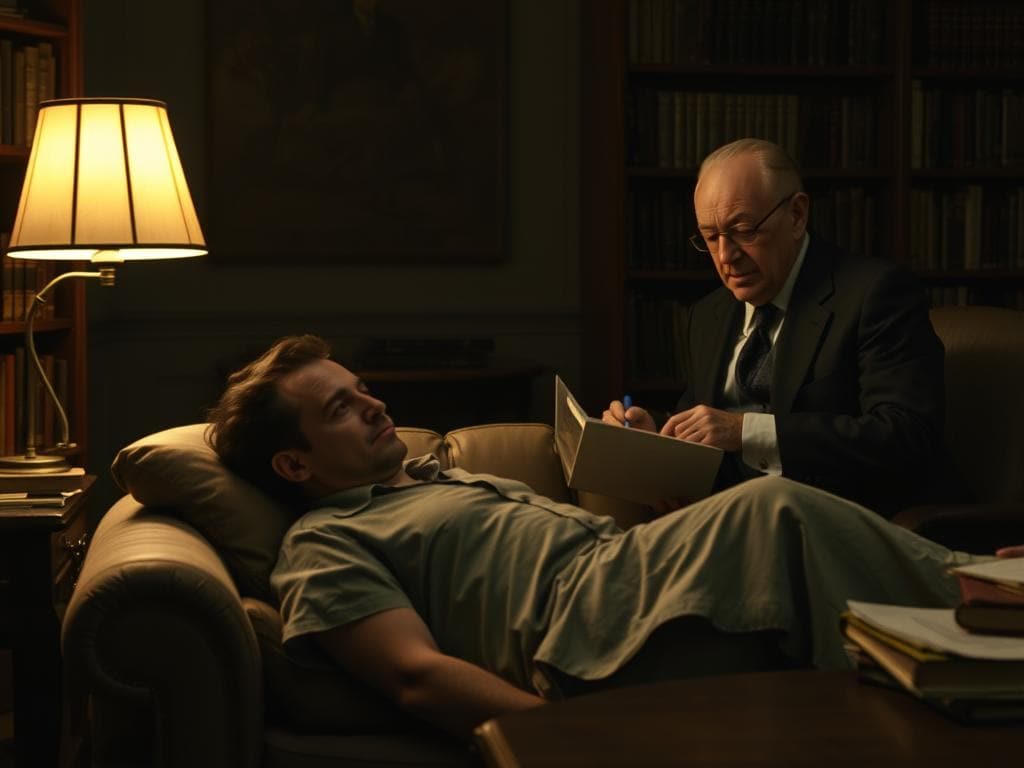
How did Freud’s groundbreaking methods uncover hidden layers of the human psyche? His techniques, like free association and dream interpretation, remain cornerstones of psychoanalysis. These methods aim to reveal repressed memories and desires that influence our behavior.
Free Association and Dream Interpretation
Free association allows individuals to speak freely, letting hidden thoughts surface. Freud believed this process bypasses conscious awareness, revealing deeper truths. For example, a person might recall forgotten memories or unresolved conflicts during these sessions.
Dream interpretation, another key method, explores the hidden meanings behind dreams. Freud saw dreams as a window into the unconscious mind. He categorized dream content into manifest (what we remember) and latent (the hidden meaning). This approach helps uncover repressed desires and emotions.
“Dreams are the royal road to the unconscious.” – Sigmund Freud
While Freud’s specifics have been debated, his overall insights paved the way for modern psychology. His methods, though developed from individual case studies, influenced mainstream ideas about the unconscious. Today, these techniques continue to shape therapeutic practices.
Freud’s work reminds us that much of our behavior is driven by forces beyond our immediate conscious awareness. By exploring these hidden layers, we gain a deeper understanding of ourselves and our actions.
Modern Research on Unconscious Influences
How much of our daily decisions are shaped by forces we don’t even notice? Modern social cognitive research has uncovered fascinating insights into how our unconscious mind influences judgment and behavior. These studies reveal that much of what we do is guided by processes outside our awareness.
Recent empirical studies show that nonconscious goals can drive behavior over extended periods. For example, researchers like John Bargh have demonstrated how subtle cues can activate goals without conscious intent. This means we might act in ways that align with our deeper desires, even if we’re not actively thinking about them.
Social Cognitive Research Findings
Social cognitive experiments have highlighted the pervasive effects of unconscious influences. In one study, participants exposed to words related to politeness acted more courteously in subsequent tasks. This priming effect shows how subtle cues can shape social interactions in real-world settings.
Another groundbreaking finding is that nonconscious goals can produce behavior similar to intended actions. For instance, individuals primed with achievement-related words performed better on tasks, even when they weren’t consciously focused on success. This challenges earlier views of the unconscious as rudimentary or “dumb.”
“The unconscious mind is a powerful force, shaping our actions in ways we often don’t recognize.”
These findings are reshaping our understanding of decision-making and self-regulation. Unlike Freud’s focus on repressed desires, modern research emphasizes the role of automatic processes in guiding behavior. This shift highlights the complexity of the unconscious mind and its impact on our lives.
By exploring these hidden influences, we gain a deeper understanding of how our minds work. This research not only broadens our knowledge of psychology but also offers practical insights into improving decision-making and behavior.
Unconscious Mind: Behavioral Influences and Cognitive Processes
What if much of what we do is guided by forces we don’t consciously control? This question lies at the heart of understanding how our unconscious mind shapes behavior. From subtle cues in our environment to hidden goals, these processes influence our actions in ways we often don’t realize.
Goal Pursuit Without Awareness
Research shows that goals can be activated outside our awareness, guiding behavior without deliberate intent. For example, studies by John Bargh reveal that priming individuals with achievement-related words can improve task performance. This suggests that our unconscious mind can drive us toward success, even when we’re not actively focused on it.
In one experiment, participants exposed to words like “strive” and “achieve” performed better on puzzles. This highlights how nonconscious goals can produce outcomes similar to those achieved through conscious effort. These findings challenge the idea that only deliberate actions lead to success.
Contextual Priming in Action
Subtle environmental cues can also shape our behavior. For instance, individuals primed with words related to politeness acted more courteously in subsequent tasks. This demonstrates how our surroundings can influence actions without us realizing it.
“The unconscious mind is a powerful force, shaping our actions in ways we often don’t recognize.”
Another study found that exposure to images of money increased self-reliance and reduced cooperation. These priming effects show how our behavior is often a response to hidden cues in our environment. This adaptability underscores the flexibility of unconscious processes in real-world contexts.
Understanding these influences can help us make sense of our actions and decisions. By exploring the hidden forces that guide us, we gain valuable insights into the complexities of the human mind.
Biological and Evolutionary Contributions
What role does biology play in shaping our hidden mental processes? The answer lies in the intricate dance between genetics and evolution. Our unconscious mind isn’t just a psychological construct—it’s deeply rooted in our biological history. From survival instincts to adaptive behaviors, evolution has shaped how we think and act without conscious awareness.
The Natural Unconscious in Evolution
Charles Darwin’s concept of “unconscious selection” offers a fascinating lens to understand this. He observed how traits evolve without deliberate intent, driven by environmental pressures. Similarly, Richard Dawkins’ “blind watchmaker” theory explains how complex systems emerge through gradual, unguided processes. These ideas highlight how many mental operations evolved outside conscious guidance.
For example, our ability to recognize danger or form social bonds is often automatic. These behaviors, honed over millennia, ensure survival and reproduction. They’re not just learned—they’re hardwired into our biology. This evolutionary perspective shows that the unconscious mind is as much a product of nature as it is of nurture.
Genetic and Cultural Factors
Genetics and culture work together to shape our hidden mental processes. Studies show that genetic predispositions influence how we respond to stress or form attachments. At the same time, cultural learning—like language or social norms—shapes our automatic behaviors. This interplay ensures adaptability across diverse environments.
Early childhood is a critical period for this development. Infants learn through imitation, absorbing cultural cues without awareness. This process lays the foundation for behaviors that feel instinctive but are shaped by both biology and environment. Freud’s theories, while focused on psychology, align with this idea by emphasizing the role of early experiences in shaping the unconscious mind.
“Nature does not hurry, yet everything is accomplished.” – Lao Tzu
Understanding these biological and evolutionary contributions helps us appreciate the complexity of our hidden mental world. It’s a reminder that much of what we do is guided by forces beyond our immediate control, shaped by millions of years of evolution.
Integrating Psychological Perspectives
How do different psychological theories come together to explain our hidden mental processes? Over the years, the study of the unconscious mind has evolved, blending insights from Freudian psychoanalysis with modern cognitive research. This integration offers a richer understanding of how our hidden mental processes shape our thoughts and actions.
Bridging Cognitive and Psychoanalytic Views
Freud’s psychoanalytic approach focused on repressed desires and early experiences. Modern cognitive psychology, on the other hand, emphasizes automatic processing and implicit learning. While these perspectives seem different, they both highlight the role of hidden mental processes in shaping behavior.
For example, Freud’s concept of the unconscious as a reservoir of repressed memories aligns with modern findings on implicit memory. Both suggest that past experiences influence current actions, even when we’re not aware of it. This overlap shows how historical and contemporary views can complement each other.
Contemporary Debates and Challenges
One major challenge is reconciling subjective psychoanalysis with objective experimental methods. Freud’s case studies were rich in detail but lacked scientific rigor. Modern research, while methodologically sound, often struggles to capture the depth of individual experiences.
Another debate centers on the definition of the unconscious. Is it a repository of repressed desires, as Freud suggested, or a hub for automatic skills, as cognitive psychologists argue? This question remains unresolved, highlighting the complexity of the topic.
“The unconscious mind is a powerful force, shaping our actions in ways we often don’t recognize.”
Looking ahead, I believe the future lies in interdisciplinary approaches. Combining insights from neuroscience, psychology, and even philosophy could offer a more comprehensive understanding of the unconscious. This integration will help us better navigate the hidden forces that influence our lives.
Conclusion
Why do we often act in ways we can’t fully explain? From Freud’s groundbreaking theories to modern research in psychology, the hidden forces shaping our behavior have fascinated experts for decades. These automatic processes, operating below our awareness, influence everything from daily decisions to long-term goals.
Understanding this interplay between hidden and conscious thought offers valuable insights. It helps us recognize how subtle cues, like priming, can shape our actions without deliberate intent. This knowledge empowers us to reflect on our own experiences and make more informed choices.
By integrating diverse perspectives—from psychoanalysis to cognitive science—we gain a deeper appreciation of the human mind’s complexity. This journey into the unseen aspects of our behavior not only enriches our understanding but also opens doors to personal growth and self-awareness.

