Have you ever stopped to wonder what reality truly is? I often find myself reflecting on how my thoughts and perceptions shape the world around me. This curiosity led me to explore the fascinating field of the philosophy of mind, where questions about consciousness, thought, and the nature of existence take center stage.
From Descartes’ famous “I think, therefore I am” to modern neuroscientific discoveries, the debate about the mind and its relationship to the body has evolved. Is the mind separate from the physical brain, or are they one and the same? These questions challenge us to rethink our understanding of reality.
In this article, I’ll bridge classic theories with contemporary insights from science. Together, we’ll examine how our mental states influence our perception of the world. Whether you’re new to this topic or a seasoned thinker, I invite you to join me on this journey to uncover the mysteries of the mind.
Key Takeaways
- The philosophy of mind explores the nature of consciousness and thought.
- Historical debates, like Descartes’ dualism, shape modern discussions.
- Neuroscience offers insights into the mind-body relationship.
- Materialism and dualism are key theories in this field.
- Understanding the mind can reshape our perception of reality.
Introduction: Rethinking Mind and Reality
What if everything we perceive as reality is shaped by our brain’s processes? This question has driven me to rethink the nature of the mind and its connection to the world around us. Over time, our understanding has shifted from early dualist views to more modern materialist perspectives.
In the past, many believed the mind was an immaterial soul, separate from the physical body. Today, neuroscience shows how brain states directly influence our conscious experience. This challenges the old notion of a detached soul and brings us closer to understanding the mind as a product of the brain.
One of the biggest challenges is reconciling subjective experience with objective brain processes. How do our thoughts and feelings arise from physical activity in the brain? This remains a central problem in the field.
Our perception of reality is not just a passive process. It’s shaped by our experiences, beliefs, and the way our brain interprets sensory information. This means reality might be more subjective than we think.
“The mind is not a thing, but a process—a dynamic interaction between the brain and the world.”
As we explore these ideas, it’s clear that the nature of the mind is deeply tied to the body and the world around us. This sets the stage for a deeper dive into the historical and scientific background in the next section.
Historical Antecedents in the Philosophy of Mind
How did early thinkers shape our understanding of the mind? The journey to explore mental phenomena began centuries ago, with ancient and medieval philosophers laying the groundwork. Their ideas continue to influence modern debates about dualism and materialism.
Ancient and Medieval Perspectives
In ancient times, thinkers like Plato introduced the concept of dualism. They believed the mind was an immaterial soul, separate from the physical body. This idea persisted through the medieval period, where religious and philosophical thought often intertwined.
Medieval scholars used language and terms to describe the soul as a divine essence. Their focus was on understanding the world through spiritual and metaphysical lenses. This period set the stage for later debates about the nature of thought and existence.
Renaissance and Modern Shifts
The Renaissance marked a turning point. Thinkers began to emphasize scientific explanations and rationalism. Figures like Descartes championed dualism, arguing that the mind and body were distinct yet interconnected.
This era also saw the rise of materialism, which views the mind as a product of physical processes. The shift from immaterial explanations to naturalistic theories reshaped our understanding of mental states and experience.
“The mind is not a thing, but a process—a dynamic interaction between the brain and the world.”
These historical perspectives laid the groundwork for contemporary debates. They remind us that our understanding of the mind is deeply rooted in centuries of thought and inquiry.
Foundational Concepts: Defining Mind, State, and Consciousness
How do we define the essence of our thoughts and experiences? This question lies at the heart of understanding the mind, state, and consciousness. These terms are often used interchangeably, but they represent distinct aspects of our inner world.
The mind is often described as the seat of thoughts, emotions, and perceptions. It’s the intangible part of us that processes information and shapes our reality. Philosophers have long debated whether the mind is separate from the brain or a product of its physical processes.
Consciousness, on the other hand, refers to our awareness of ourselves and the world around us. It’s the state of being awake and able to experience sensations, thoughts, and feelings. Some philosophers distinguish between phenomenal consciousness (what it feels like to experience something) and access consciousness (the ability to use that experience in reasoning).
Mental states are another key concept. They describe the various forms our thoughts and emotions can take, such as happiness, sadness, or curiosity. These states can be both subjective (how we feel) and objective (how they manifest in the brain).
Understanding these definitions is crucial for exploring deeper questions about the nature of mental life. For example, how do our inner experiences arise from physical brain activity? This remains one of the most challenging thought experiments in the field.
“Consciousness is not just a product of the brain; it’s the lens through which we perceive reality.”
Philosophers and scientists continue to study these concepts, seeking to bridge the gap between subjective experience and objective observation. By defining these foundational terms, we can better navigate the complex landscape of mental phenomena.
Dissecting the Mind-Body Problem
What if the connection between our thoughts and physical body is more complex than we imagine? This question lies at the heart of the mind-body problem, a central puzzle that has intrigued thinkers for centuries. It explores how our mental experiences, like pain or desire, relate to the physical processes in our brain.
Key Philosophical Challenges
One of the biggest challenges is understanding the cause and effect between neural events and subjective experiences. For example, how does a physical injury lead to the sensation of pain? This interaction raises questions about whether the mind and body are separate or deeply intertwined.
Descartes famously argued that the mind and body are distinct yet interact. His dualist account suggests that the mind is immaterial, while the body is physical. However, this raises further questions about how these two entities interact.
Modern thinkers also grapple with the role of subjective reports. How do our personal experiences, like desire or emotion, fit into a material world? These questions challenge us to rethink the nature of reality.
Scientific Insights into Brain Processes
Advances in neuroscience have shed light on how brain processes correlate with mental states. For instance, studies using brain imaging show that specific neural activity corresponds to feelings of pain or pleasure. This suggests a direct link between physical events and subjective experiences.
Experiments have also explored the time delay between sensory input and conscious awareness. For example, a stimulus might reach the brain in milliseconds, but we may not become aware of it until later. This challenges our understanding of how cause and effect work in the mind.
Descartes’ ideas remain influential, but modern science offers new perspectives. By examining both historical accounts and contemporary findings, we can better understand the complex relationship between mind and body.
“The mind and body may seem separate, but their interaction is the key to understanding consciousness.”
As we delve deeper into this topic, it’s clear that the mind-body problem is not just a philosophical debate. It’s a fundamental question about the nature of our existence. By exploring both historical theories and scientific evidence, we can begin to unravel this enduring mystery.
Dualism: Exploring the Mind-Body Distinction
What if our thoughts and physical sensations are entirely separate? This question lies at the heart of dualism, a perspective that views the mind and body as distinct entities. Dualism challenges us to rethink how we perceive the relationship between our inner experiences and the physical world.
Descartes and Substance Dualism
René Descartes is often credited with formalizing dualism. He argued that the mind and body are two separate substances. The mind, according to Descartes, is a thinking, non-extended thing, while the body is an extended, non-thinking thing. This distinction suggests that the mind could exist independently of the body.
Descartes’ substance dualism has had a lasting impact. His idea of the mind as an immaterial soul has influenced both philosophical and theological discussions. For example, he believed the mind’s indivisibility supported the possibility of an afterlife. This aspect of his theory remains a cornerstone of dualistic thought.
Arguments for Property Dualism
While substance dualism focuses on distinct substances, property dualism takes a different approach. It argues that mental properties, like consciousness, depend on the brain but are not reducible to physical properties. This means that while the brain enables mental states, these states have unique qualities that cannot be fully explained by physical processes.
Memory and subjective experience play a key role in supporting property dualism. For instance, the way we recall events or feel emotions cannot be entirely mapped to neural activity. This respect for the complexity of mental life highlights the limitations of purely materialistic explanations.
“The mind and body may interact, but their fundamental differences challenge our understanding of existence.”
Dualism continues to shape debates about mental causation and the nature of consciousness. It raises important questions about how the mind and body interact, if at all. While some argue that dualism is inconsistent with modern science, others believe it offers a valuable framework for understanding the complexities of human experience.
In my view, dualism provides a compelling way to explore the mysteries of the mind. It reminds us that there is still much we don’t understand about the relationship between our thoughts and the physical world. By examining both historical and modern perspectives, we can gain deeper insights into this enduring philosophical debate.
Monism and Materialism: Alternatives to Dualism
Can our mental experiences be fully understood through physical processes? This question lies at the heart of monism and materialism, which offer compelling alternatives to dualism. Unlike dualism, which separates the mind and body, monism argues that everything can be explained through a single fundamental substance—often physical matter.
Physicalism, a dominant form of monism, claims that only physical properties exist. This theory suggests that mental states are nothing more than brain states. For example, feelings of joy or sadness arise from specific neural activities. This view aligns with modern science, which increasingly links mental phenomena to physical processes in the brain.
Physicalism and Its Variants
Central state materialism is one variant of physicalism. It posits that mental states are identical to brain states. This means that every thought or emotion corresponds to a specific physical event in the brain. Studies using brain imaging have provided strong evidence for this theory, showing how neural activity maps to subjective experiences.
Another approach is eliminative materialism, which challenges the existence of certain mental phenomena. For instance, it argues that concepts like “belief” or “desire” may not be useful in explaining behavior. Instead, it focuses on purely physical explanations.
Non-Reductive Approaches to Mental Properties
Non-reductive physicalism offers a middle ground. It acknowledges that mental properties depend on the brain but cannot be fully reduced to physical processes. This approach respects the uniqueness of consciousness while still grounding it in the physical world.
For example, subjective experiences like the taste of coffee or the color red cannot be entirely explained by neural activity alone. Non-reductive physicalism argues that these experiences have qualities that go beyond their physical basis.
“The mind is not separate from the body; it is a product of the brain’s complex processes.”
These theories highlight the strengths of monistic views in explaining consciousness. They bridge the gap between subjective experience and objective observation, offering a more unified understanding of the mind.
In my view, materialism provides a robust framework for exploring mental states. While challenges remain, its alignment with modern science makes it a powerful tool for understanding the complexities of the mind.
Philosophy of Mind: Core Debates and Theoretical Perspectives
How do we reconcile the subjective nature of consciousness with objective scientific observations? This question lies at the heart of the core debates in the philosophy of mind. It challenges us to examine whether consciousness can be reduced to brain processes and how first-person experience is explained by third-person science.
One of the central controversies is the divide between dualism and materialism. Dualism argues that the mind and body are distinct entities, while materialism claims that mental states are entirely physical. This debate has shaped our understanding of the mind’s nature and its relationship to the body.
Another key issue is the causal role of brain processes. How do neural activities give rise to subjective experiences like perception or emotion? This problem highlights the tension between objective measurement and personal experience. For example, brain imaging studies show correlations between neural activity and mental states, but they don’t fully explain the qualitative aspects of consciousness.
Philosophers from Descartes to contemporary thinkers have framed these debates in various ways. Descartes’ dualist view emphasized the separation of mind and body, while modern materialists argue that mental properties are rooted in the brain. These perspectives continue to influence how we understand the mind’s process and its connection to the physical world.
“The mind is not a thing, but a dynamic interaction between subjective experience and objective reality.”
Clear language and precise terminology are crucial in these discussions. Terms like “mental properties” and “consciousness” must be carefully defined to avoid confusion. This clarity helps us analyze theoretical perspectives that seek to reconcile first-person and third-person accounts.
In my view, these debates are essential for advancing our understanding of the mind. They remind us that the nature of consciousness is complex and multifaceted. By exploring these core issues, we can lay the groundwork for discussing specialized theories like identity theory in upcoming sections.
Identity Theory of Mind: Brain States and Experiences
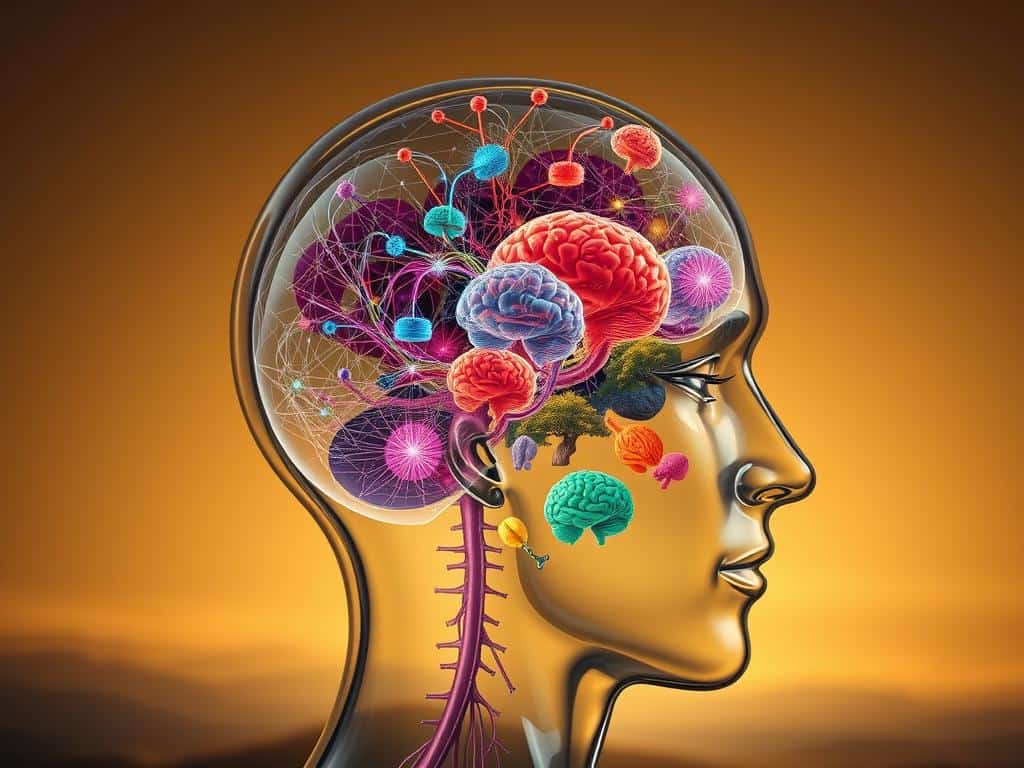
What if our thoughts are simply the result of brain activity? This question lies at the heart of the identity theory of mind. It suggests that mental states are identical to brain states, offering a materialist perspective on consciousness.
Identity theory emerged in the 1950s, with thinkers like U.T. Place and Herbert Feigl leading the way. They argued that sensations and thoughts are not separate entities but processes in the brain. This theory challenges traditional dualist views, which separate the mind and body.
Central-State Materialism Explained
Central-state materialism is a key variant of identity theory. It posits that mental states are identical to brain states. For example, feelings of joy or sadness correspond to specific neural activities. This approach aligns with modern neuroscience, which links mental phenomena to physical processes.
One of the strengths of central-state materialism is its simplicity. It reduces complex mental experiences to measurable brain events. However, critics argue that it struggles to explain the subjective sense of consciousness, known as qualia.
Mapping Mental Processes to Neural Activity
Neuroscience has made significant strides in mapping mental processes to neural activity. Studies using brain imaging show how specific neural patterns correlate with subjective experiences. For instance, research by Redinbaugh et al. (2020) demonstrated that stimulating the thalamus can alter consciousness in macaques.
These findings support the idea that mental states are rooted in the brain. Yet, they also highlight the challenge of reducing subjective experience to purely physical events. How do we explain the “what it feels like” aspect of consciousness?
“The mind is not separate from the brain; it is a product of its complex processes.”
Identity theory offers a compelling framework for understanding the mind. While it faces challenges, its alignment with modern science makes it a powerful tool for exploring consciousness. By examining both historical debates and contemporary findings, we can better understand the intricate relationship between brain and mind.
The Hard Problem of Consciousness
Why does it feel like something to experience the world? This question lies at the heart of the hard problem of consciousness. Unlike other scientific challenges, this problem focuses on the subjective, qualitative aspects of experience—what philosophers call “qualia.”
Qualia refer to the individual, personal part of our experiences, like the redness of a rose or the bitterness of coffee. These sensations are deeply subjective, making them difficult to explain through purely physical processes. This is why many philosophers and scientists consider consciousness uniquely complex.
Understanding Subjective Qualia
Qualia challenge reductive scientific explanations. For example, while we can measure brain activity when someone sees the color red, we cannot fully explain why it feels the way it does. This gap between objective data and subjective experience is what makes qualia so problematic.
David Chalmers, who coined the term “hard problem,” argues that consciousness cannot be fully explained by physical processes alone. He contrasts this with “easy problems,” like understanding brain functions, which can be addressed through scientific study.
One of the most striking examples of qualia is color perception. Two persons might see the same color but experience it differently. This subjectivity highlights the limitations of reductive explanations and raises deeper questions about the nature of consciousness.
“The hard problem is not about how the brain processes information, but why it feels like something to do so.” — David Chalmers
Experimental approaches, like brain imaging, aim to bridge the gap between neural data and subjective experience. However, these methods often fall short of explaining the “what it feels like” aspect of consciousness. This thought has led some to explore alternative theories, like panpsychism or dualism.
In my view, the hard problem reminds us that consciousness is more than just a type of brain activity. It’s a deeply personal and subjective phenomenon that continues to challenge our understanding of the mind. By exploring qualia, we can better appreciate the complexity of our inner experiences.
Interplay Between Conscious Experience and Neuroscience
How does the brain transform sensory input into conscious experience? This question drives modern neuroscience, which seeks to uncover the mechanisms behind our perception of the world. Recent advancements have begun to clarify how brain activity correlates with conscious experience, challenging traditional dualistic accounts.
Linking Brain Activity to Perception
Neuroscientific research has made significant strides in linking neural activity to perception. For example, studies using fMRI have shown that specific brain areas light up when we experience sensations like pain or pleasure. This interaction between neural processes and subjective experience raises important questions about the cause and effect of consciousness.
One groundbreaking study demonstrated how stimulating the thalamus alters consciousness in macaques. This suggests that certain brain regions play a critical role in shaping our conscious experience. Such findings challenge the idea that the mind and body are separate, as proposed by Descartes.
Modern imaging technologies, like the BOLD signal in fMRI, measure changes in blood flow to map brain activity. These tools have revealed how sensory data is transformed into conscious perception. For instance, when we see a color, specific neural patterns activate, creating the subjective experience of that color.
“The brain is not just a passive receiver of information; it actively constructs our reality.”
These discoveries challenge traditional dualistic accounts. Instead of viewing the mind as an immaterial entity, neuroscience suggests that mental states are deeply rooted in physical brain processes. This material perspective offers a more unified understanding of consciousness.
In my view, the interplay between brain and experience is one of the most fascinating areas of study. It reminds us that our perception of reality is not just a reflection of the external world but a product of complex neural interactions. By exploring these mechanisms, we can better understand the nature of consciousness and its connection to the brain.
The Role of Language and Perception in Shaping Reality
How does the language we use shape the way we perceive the world? This question lies at the heart of understanding how linguistic frameworks influence our mental states and consciousness. Words are not just tools for communication; they actively shape our reality.
Language provides the structure through which we interpret experiences. For example, the phrase “I think, therefore I am” highlights how language can define existence. This theory suggests that our thoughts and perceptions are deeply intertwined with the words we use to describe them.
Cultural background also plays a significant role in shaping perception. Studies show that individuals from different cultures interpret gestures or expressions in varying ways. This highlights how language and culture influence what we consider real and measurable.
Modern science has further explored this connection. Research indicates that speakers of languages with multiple color terms can distinguish colors more accurately. This demonstrates how linguistic diversity enhances perceptual abilities.
“Language is not just a mirror of reality; it is a tool that constructs it.”
Philosophical discussions about term definitions also shape our worldview. For instance, debates over the nature of consciousness often hinge on how we define key concepts. This shows that language both reveals and shapes our internal experiences.
In my view, the role of language is central to understanding the interplay of perception and reality. By examining how linguistic frameworks evolve, we can better appreciate the complexity of our mental states and their connection to the world around us.
Psychophysical Parallelism and Occasionalism
What if the mind and body operate independently yet in perfect harmony? This question lies at the heart of psychophysical parallelism and occasionalism. These theories challenge the idea of direct interaction between mental and physical events, proposing instead a coordinated relationship.
Psychophysical parallelism suggests that mental and bodily events run parallel without causal interaction. For every mental event, there is a corresponding physical event, but neither directly influences the other. This theory aligns with the idea of a pre-established harmony, as argued by Leibniz.
Leibniz believed that the mind and body function independently, yet their actions appear coordinated due to a divine plan. This sense of harmony ensures that mental and physical events align perfectly, even without direct causation.
Exploring Parallel Causal Theories
Occasionalism, defended by Nicolas Malebranche, takes a different approach. It suggests that God intervenes to coordinate mental and physical events. Instead of direct interaction, divine intervention ensures that the mind and body operate in sync.
These theories offer an alternative to dualism and materialism. While dualism separates the mind and body, and materialism reduces mental states to physical processes, parallelism and occasionalism propose a middle ground. They acknowledge the connection between mental and physical events without asserting direct causation.
“The mind and body may not interact directly, but their harmony is orchestrated by a higher power.”
One strength of these theories is their ability to explain the correlation between mental and physical events. However, critics argue that they rely too heavily on metaphysical explanations, such as divine intervention or pre-established harmony.
In my view, these theories provide a fascinating perspective on the mind-body relationship. They remind us that the world of mental and physical phenomena is more complex than it appears. By exploring these ideas, we can better understand the intricate balance between our thoughts and bodily processes.
Experiential Dualism: Beyond Simple Mind-Body Categories
What if our sense of self is more than just a product of brain activity? This question lies at the heart of experiential dualism, a perspective that acknowledges both physical processes and the irreducible quality of subjective experience. It challenges us to rethink how we categorize the mind and body.
Experiential dualism suggests that while brain activity underlies our thoughts and feelings, there is a unique, subjective part of consciousness that cannot be fully explained by physical processes. This form of dualism expands on traditional debates by recognizing the nuanced relationship between the physical and the experiential.
Implications for Personal Consciousness
Personal consciousness, according to this view, defies strict categorization. It is both the result of brain activity and something that feels fundamentally unique. This duality raises important questions about how we understand self-awareness and identity.
For example, the way we experience joy or pain is tied to neural processes, yet the subjective sense of these emotions feels distinct from their physical origins. This thought challenges scientists and philosophers to find ways to bridge the gap between objective data and personal experience.
“Consciousness is not just a byproduct of the brain; it is the essence of our lived reality.”
Experiential dualism also influences debates about free will and desire. If our experiences are both physical and subjective, how do we reconcile these aspects when making decisions? This position highlights the complexity of human agency and the interplay between our inner world and external actions.
In my view, this approach offers a richer understanding of consciousness. It reminds us that our experiences are not just types of brain activity but deeply personal phenomena that shape our reality. By exploring experiential dualism, we can better appreciate the intricate balance between the physical and the subjective.
Emergent Materialism and Its Intersection with Psychology
How do complex systems give rise to consciousness? This question lies at the heart of emergent materialism, a theory that suggests mental phenomena emerge from intricate physical interactions in the brain. Unlike strict reductionist views, this approach acknowledges that consciousness cannot be fully explained by basic brain activity alone.
Emergent materialism posits that new properties, like consciousness, arise from the complexity of physical systems. For example, the brain is more than just a collection of neurons; its interactions create something greater than the sum of its parts. This theory bridges the gap between philosophy and psychology, offering a nuanced understanding of the mind.
One of the key ideas is that psychological processes cannot be entirely reduced to cellular activity. While brain states are foundational, higher-order mental states, like decision-making or creativity, emerge from the system as a whole. This challenges the reductionist sense that everything can be broken down into simpler components.
Historically, emergent materialism gained traction in the early 20th century but faced a decline with the rise of reductionism. Today, it’s experiencing a resurgence, thanks to advancements in cognitive science. Research shows that complex brain networks give rise to phenomena like memory and perception, supporting the idea of emergence.
“Consciousness is not just a byproduct of the brain; it’s an emergent property of its complex interactions.”
However, this theory faces challenges. Explaining the qualitative aspects of consciousness, or qualia, remains difficult. How does the brain’s physical activity create the subjective experience of seeing color or feeling joy? This question continues to puzzle scientists and philosophers alike.
In my view, emergent materialism offers a compelling framework for understanding the mind. It aligns with modern neuroscience while respecting the complexity of human experience. By exploring this theory, we can better appreciate the intricate relationship between the brain and consciousness.
Interdisciplinary Perspectives on Mind, Consciousness, and Reality
How do different fields of study come together to explain the mind and consciousness? This question drives interdisciplinary research, which combines insights from cognitive science, neuroscience, and philosophy. By integrating diverse methods, researchers can tackle age-old problems about the nature of thought and experience.
Contributions from Cognitive Science
Cognitive science provides experimental and theoretical insights into mental processes. For example, studies on memory and perception reveal how our brains interpret sensory data. This study helps us understand the mechanisms behind conscious experience.
One key area is the exploration of decision-making. Cognitive scientists examine how we weigh options and make choices, shedding light on the thought processes that guide our actions. These findings bridge the gap between abstract theories and practical applications.
Neuroscientific Advances Informing Philosophy
Neuroscience offers concrete evidence linking brain activity to conscious thought. For instance, research using fMRI shows how specific neural patterns correlate with subjective experiences like pain or joy. This data challenges traditional philosophical positions and supports a more unified understanding of the mind.
Recent advancements, such as the study of long COVID, highlight the connection between cognitive deficits and physical symptoms. This form of research demonstrates how interdisciplinary efforts can address complex questions about health and consciousness.
“The mind is not just a product of the brain; it’s an emergent property of its complex interactions.”
In my view, combining philosophy, psychology, and neuroscience offers a richer account of experience and reality. While challenges remain, this unified approach provides a powerful framework for exploring the mysteries of the mind. By integrating diverse perspectives, we can better understand the intricate relationship between our thoughts and the world around us.
Conclusion
Exploring the nature of thought and reality has been a journey of discovery and reflection. From Descartes‘ dualism to modern materialist views, the debate over the mind and body continues to shape our understanding of consciousness. Historical accounts remind us that these questions are not new, yet they remain central to both philosophy and science.
The challenge of connecting brain processes with subjective experience, such as pain or desire, highlights the complexity of this field. Interdisciplinary research, combining neuroscience, psychology, and philosophy, offers promising directions for resolving these longstanding issues. Over time, significant progress has been made, but many questions remain unanswered.
In my view, the interplay between the mind and body is one of the most fascinating aspects of human existence. It reminds us that our understanding of reality is shaped by both objective data and personal experience. By engaging with historical debates and cutting-edge research, we can continue to explore the mysteries of consciousness.
I encourage readers to embrace integrative thinking about the mind, body, and reality. While the journey is ongoing, it is through this exploration that we deepen our understanding of ourselves and the world around us.

